Season Report 06'

After viewing this web version of the season report you can download the un-abridged report with more details & photographs. This annual report is created after I disappear under the notable MSR outfitter wing / bug house each evening to capture the days’ events in a field journal. The journals have been more or less faithfully maintained for 30 years, based upon the Grinnell system, taught by zoologist Dr. Steven G. Herman. Special thanks to the fly-fishers who traveled with Wild River Guides and Extreme Fly-Fishing Productions for the first time.

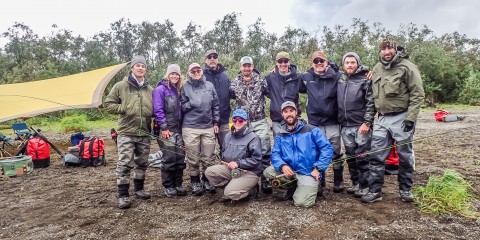
I owe a debt of gratitude to the fly-fishers who returned for a second, third or even tenth season. Returning guests included Bruce, Jim, Bill, Hank, Kate, Joe, Rich, & John. In 2006 I continued blending retail guided fly-fishing trips with wilderness journalism trips. “Wild River Guides” has a sister company named “Extreme Fly-fishing Productions” which provides logistic support for filmmakers, artists, writers, wildlife photographers, and journalists. Special thanks to those photographers and writers who documented the season including Mr. R. Voss - photographer, Mr. R.A Beattie -Filmmaker, Mr. J. Merritt -Fiction, and Mr. J. Markoff -New York Times journalist, who shared some of their creative process with me on the vast landscape.

Report for the First Recorded Descent of an Alaskan River, by Mark Rutherford & R.A. Beattie: July 5-July12

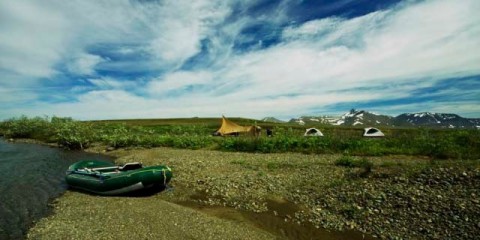
R.A. Beattie teamed up with me to undertake the first raft descent of a river in the Bristol Bay region. To execute the descent required a year of preparation. To find out if the tributary was fundamentally “do-able” prior to our descent, we spent the requisite hours in bush planes on reconnaissance flights, performing aerial still photography, aerial video, studying satellite imagery, and performing GPS and map work. For several years prior to the descent I interviewed regional fishing & hunting guides, bush pilots, and locals and determined that above a certain point this boreal river was entirely obstructed by log jams. Below that point, the lower 1/3 of the river is a jealously coveted piece of trout, char, & salmon water which is accessible by fly out lodge guests and fished by jet boat for a few weeks each summer.

A year of planning and weighing selected gear on scales and today the challenge was to portage 496 pounds of equipment ½ mile through wet tundra, oxbow swale, willow, alder, and finally the narrow band of white spruce along the river margin. I didn't know at this stage of the trip which piece(s) of gear to curse as excess weight. A contender from the start for the most cursed object was the massive tripod.

What is it really like with 110 pounds of raft one your back while waist deep in mud? It actually is as horrible as it sounds. The sheer terror of potentially failing at this and breaking a leg is so frightening that one focuses with complete attention on the task at hand. There is barely enough free space in your brain to realize that you are hemorrhaging from thousands of mosquito bites. All your effort is focused on just taking one more step without falling. Then breathing, then staggering toward the next hummock. And again breathe, then shift the load, then breathe, then disregard the burning pain in the knee, lurch forward. The only thought I carried that was not purely mission focused was gratitude that I was doing this with R.A. Beatty. I do not know anyone else who could suffer this much for fishing and whom I could depend upon not to go to pieces either emotionally or physically.

The major log jam was sighted mid day on our fourth day. That morning was spent filming spectacular rainbow, char, and grayling fishing among the spawning chum salmon. Hindsight would show that this reach of river bracketing a few miles above and below the massive log jam fished the best for us. It turned out that the real story was not in overcoming the log jam portage but in opening our eyes to the life contained within the logs.

The Lower River: July 11 “The Chum were spawning in black cobble the size of tennis ballsÄthe river flowing through a rolling taiga landscape with a thin margin of spruce and cottonwood with a sprinkling of birch and alder.” The day was spent filming the excitement of sight casting to leopard rainbows. Hours were spent setting up tripods, filming the raft coming down the river, sighting fish among the chum salmon redds, and for our reward at the end of all the logistics of filming would be a leaping rainbow. Three different spawning beds were filmed with the hopes that we might have some good footage.

Notes** Our expedition, at the time of this writing, is thought to be a “first rafting descent.” Due diligence researching sources from government agencies to regional experts can find no indication that it has ever been attempted by raft or canoe. The location of this small river is for the time being withheld at our discretion based on our concern that publication may cause a surge of interest and fishing pressure

The First Descent Project could not have been undertaken with the finest outdoor gear from: Aire / Outcast for rafts, Scott for fly rods, Sage for fly rods. Ross for reels, Ortlieb for dry bags, Simms for waders, jackets, & dry bags, MSR for tents, Cascade Designs for Thermarest pads, Mountain HardWear for sleeping bags, Cannon for cameras, Nikon for cameras, Coleman for stoves, Smith / Action optics for polarized glasses, Alaska Fly Shop for flies, Starbucks for coffee, Rite in the Rain for waterproof journals, National Geographic for waterproof map paper, Garmin for GPS. Counter Assault for bear spray, NRS for raft frame,

Tundra Creek, John Merritt group.
July 14-22 - An Extreme Fly-Fishing Productions Trip.

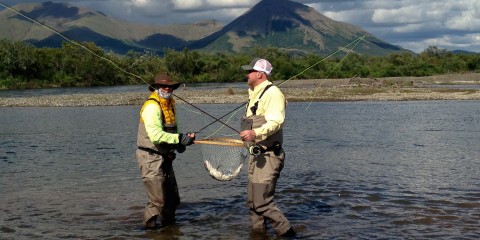
Fiction author John Merritt continued work on a wilderness fiction story inspired by the Bristol Bay region of Alaska. The venue was a seven day raft trip down a diminutive tributary of a great Bristol Bay Salmon stream. Hank Ashforth, President of the board of Oregon Trout, rowed the second boat with camp gear. Joe Merrill, Chairman of the board of Connecticut Chapter of the Nature Conservancy provided the camera support. No other fishermen were seen for the 21 miles fished and our evenings were spent listening to readings by fly fishing authors. It was a week of great trout fishing combined with a raft based “Fly-fishing Book Club”!

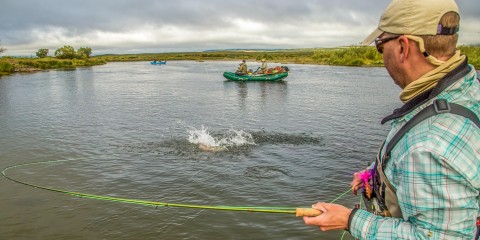
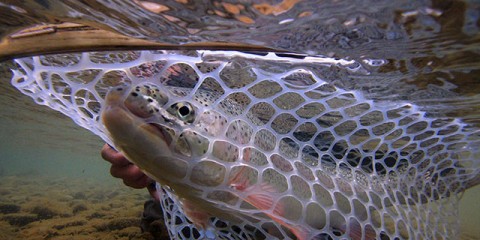
On day three the cold, cloudy, marine, air mass which had blanketed the Bristol Bay for the past five days broke open to dizzying sunshine (for a few hours). The fishing popped open too. After coffee John and the guys fished above camp taking 6 Rainbows, 3 Chum, and 6 Grayling while a cow moose browsed by. The day's travel began in the mode of leapfrogging the 2 rafts from pool to pool. One raft stops and takes first casts to the pool and riffle and then the other passes quietly through the pool until stopping at the next run to get out and wade / cast and so forth. After lunch 14 Rainbows to 25 inches were released. Hank Ashforth cast mice through water both “froggy” and “rapid” and certainly accounted for most of the trout struck. Mr. Merrill took the largest trout. John and I managed a fish or two as well.

From the log of July 9, 2006. Another great Grizzly Bear observation this time as we ate lunch on a tundra bluff, the bear appeared below us and across the stream. A nice safe way to observe the great animals! John killed a bright sockeye for dinner and the night was given to loon calls.

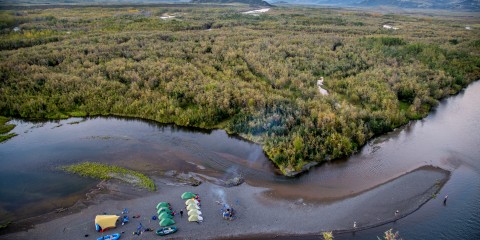
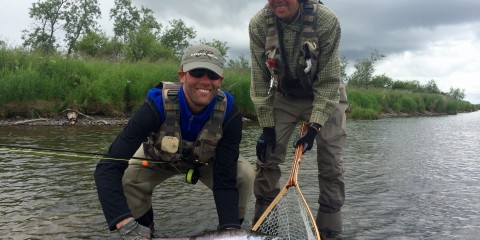
The following evening we set up camp at the mouth of a tiny tundra seep in a pepper scented sedge meadow where a hen Green Wing Teal burst through the sedges, essentially into our camp, quacking hysterically while herding downy ducklings ahead of some unseen terror in the deep grass. A Mink in “murder mode” we thought. Again Joe Merrill caught some really nice trout. One large trout taken by Joe today is ranked “his personal best” for a wild trout. That's two “biggest trout of a lifetime” produced by this little river in one week, and caught by guys who fish in Bristol Bay with me regularly. Very nice fishing and some terrific fly fishing prose under way by Mr. Merritt, stay tuned.

“No Lake Creek,” Koenig group July 23-29: An Unsuccessful First-descent becomes a successful Char trip

No Lake Creek is tantalizing, like many other un-run creeks which may host rainbows. This past year, fly-fisher Howard Koenig and Dolly Varden specialist Charlie Malmgrenteamed up with me to attempt a first descent of the creek. I had researched the fishery over the years by fishing the creek at the confluence with the major salmon river below. The confluence fishes beautifully and produces rainbows which are lovely, wild, leopard spotted fish. Radio tagged rainbows have been recorded over-wintering in No Lake Creek by fisheries biologists. The stage was set for an attempt at a first descent of an un-rafted rainbow stream.

Every Alaskan river trip needs a back up plan, or several back up plans, to accommodate nature's forces, such as the weather, and river levels, and also the human element as well such as lost luggage, torn rotator cuffs and those sorts of things. We invoked our backup plan and floated the primary salmon spawning river instead of the No Lake Creek tributary option. If we couldn't float down it we would raft the main stem to the confluence with No Lake Creek and hike up it! And in this we were fully successful. We also “over-achieved” on grizzly bear sightings on this trip but that is another story!

Nine species in one day on one river! Howard fished the main-stem river with intensity and focus for upwards of 16 hours per day. This was his first Alaska trip and he says “when I come back I'm going to cut my sleep down to 4 hours per night” allowing a fuller 20 hours per day to fish! He is the only guest of mine to record catching 9 species in one day on one river. Grayling, Dolly Varden, Rainbow, Sockeye, Chum, King, Pink, Whitefish, Arctic Char

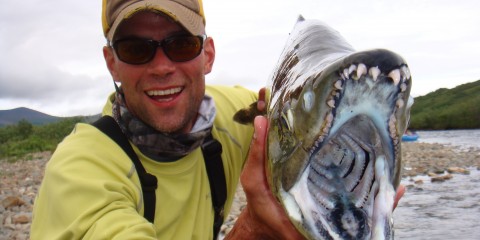
If you want to “take home” some facts about char, here is Charlie talking: “The rainbows were found in the woody debris and along the •brown to green transition' in water depth, which is what you expect while the char were in deeper water. The Char are hyper-aware of raptors and are going to prefer the deeper water if available. I looked for 6' deep or deeper pools on our trip that were below active Chum and Pink spawning. The size and coloration of the fish we were catching was indicative of char that have just recently left the salt. They were 1 or 2 salt fish entering the system months before they will spawn. They'll need 39 degree water to spawn in which won't happen until October.” To learn more about Char in Alaska or North America, you'll do well by fishing with Charlie Malmgren.

The South Fork, Extreme Fly-Fishing Invitational Trip: July 30-August 6:

The point of Alaska's annual “Invitational Extreme Fly-fishing Trip” is to promote cross fertilization of wilderness travel techniques, and fly-fishing skills, while traveling across a vast Alaskan landscape. There are qualitative differences of outcome year upon year to the Invitational trips that are difficult to put into prose. Generally there is more physical intensity because the participants tend to be expert, current, or past professional outdoors people in top physical fitness for their ages.

To perfect the skill-set that a wilderness rafting fly-fisher needs we watched Mr. Voss: He has the ability to “pick the low hanging fruit,” or to “cherry pick” the most productive water and keep the fly in that productive water as he travels down 30 miles of river. The aggressive characteristics of large rainbows and char take care of much of the rest. How “to read” the most productive water is the million dollar question. You'll just have to ask him! At days end we ate Dutch oven pizzas topped with olives, mushrooms, pesto, and artichoke hearts while a scruffy young caribou walked past camp.

From the Log of August 4, 2006: “Out of camp early and the fishing was fabulous! Dolly Varden nearly every cast on egg patterns for four miles. Those 4 miles are historically the most productive of the trip.” The river reaches a balance between environmental factors, the geological gradient, the hydrologic functions of sediment transport, the biomass of tons of salmon flesh in the water. Richard and I contrived to fish together all day while the good doctor rowed us and we caught as many fish as we wished. 94 Dolly Varden, 18 Rainbow trout released, and one coho killed for dinner.

At the conclusion of the trip Mr. Voss was presented with the coveted “Barbie spin cast outfit” prize for service to our floating “Wilderness Community.” He contributed day after day, cast after cast, and shared the distillate of more than three decades of professional Wilderness conservation work.

Report for the South Fork Trip, Bruce Rueben & Jim Hanko. Peak of the Coho run. August 7-15:

Bruce Rueben and Jim Hanko fished the peak of the Coho run on the South Fork with me. Between the two Minnesota anglers they have amassed a huge amount of fly-fishing experience from Striped Bass in Maine, Northern Pike in Canada, to Steelhead trout and all the North American coldwater species. In Alaska they helped me pioneer “Alberta Creek” with the third recorded descent of the creek in 2003.

From the Log of August 9, 2006: “On the water for 9 hours” pushing and dragging rafts through shallow waters of the mountain pass and onto the coastal plain. At mid day we fished 1&1/2 hours at the “Sockeye Festival” noted the previous week with tremendous results for Dolly's and Rainbows. But mainly we moved to get into position amid the tremendous spawning beds in the middle reach.We arrived in the “Hot Zone” late in the day. “Released 36 Dolly's, 12 Rainbows, 2 Grayling, 6 Sockeye, and 2 Coho.”

As we proceeded through the primary spawning water the weather steadily deteriorated and set into a 5 day pattern of squally, marine weather, never horrid but never really nice. The river rose steadily for 36 hours adding ten inches of depth and reducing visibility to 3-4 feet at the worst. Fishing became considerably more difficult because the aggregations of spawning salmon were partly obscured by the algae flotsam washed off the gravel bars by rising water. 22 Dollys, 7 rainbows, and miscellaneous salmon were released today.

From the Log of August 12, 2006: Within a dozen miles of the estuary now; White Fronted Geese crying as they traded across the flats, gathering in ever larger flocks. Sandhill Cranes, Ravens, and gulls contributed to a raucous sound-scape. We've fished and traveled four days/ 35 miles since the portage and are solidly among the Coho. 53 Coho released today and 1 killed for supper.

Bruce & Jim fished from mid morning until late evening with breaks for lunch and dinner among the largest group of Coho I've ever seen in the river. All the fly-fishing techniques for enticing Coho worked today from sight fishing leeches in the side sloughs to skating dry flies on the sand flats. Coho charging after Pink Polly Wogs however, produced the most desirable mental state and who would blame an angler for such indulgence?

Note to the 2006 season's participants:
As you reflect back on your trip I hope you feel proud of your experiences. I believe that you accomplished something far beyond the experience of the average angler coming to Alaska.

For those who will be fishing with Mark next year:

Planning the trip takes time: Start the process as soon as you can. Deploy your dollar resources thoughtfully on quality tackle and outerwear, more is not better, be fit, travel with essentials as “carry on bags”, and if we are doing a low water trip- or a portage- be prepared to work hard to get to the best wild trout and salmon fishing in Alaska!

Client Words
“I just finished reading the report of our 2006 trip. Nicely written. Thoughtful and generous. A joy to reflect on those days and nights and..."
- Leslie Terzian

View Testimonials

Watch Wild River Guide Videos


Home | About | Contact Us | Site Map