Wild River Guide Co. Gear Discussion

To a large degree the success of Alaskan backcountry travels depend on packing the right type and correct amount of clothing & gear. (Not to minimize the other essential factors of good route-finding judgment, good weather, and good timing). Weather in Alaska in June, July and early Aug will often surprise us with 16-20 hour/day sun and moderate temperatures from 50-80 degrees. However, right type and amount of clothing & gear prepares you for seasonal thunderstorms or stormy weather fronts originating from the Bering Sea or Gulf of Alaska. The right type and amount makes a difference between a week of comfort in changeable weather vs. a week of shivering should the weather turn windy/rainy. If your trip includes the months of May, early June, late August, September, you’ll see temperatures from 20-60 degrees and require just a few additional items such as a hooded fleece sweater or jacket & gloves.

Mark’s wilderness trips require the right type and amount of gear, more so than a National Park road trip or a lodge based trip because we will live in Alaska’s classic wilderness for a week or so. I am here to help you celebrate traveling and fishing and participating in that wilderness. The wilderness qualities we seek are no longer found along the Alaskan roadside or in the more accessible day trip fly-out areas frequented by lodges and tours. To travel beyond the ordinary bounds of civilization means we fly in and out in high performance bush planes. We carry everything to and from the campfire, we pack and unpack our boats daily. We take the right type and amount because our planes and boats and shoulders have meaningful weight limits beyond which performance deteriorates and cutting corners compromises safety, which we don’t do. Pack light!

The gear you bring, borrow & buy for our adventure will help you enjoy hiking up an Alaskan wilderness ridge to photograph or paint wildflowers & caribou or enjoy a spot to fish alongside a wolf track filling with water in the river’s beach sand.

Early in your planning phase talk to me about your goals because they affect our gear / weight limits and the type of aircraft we fly and boats we use. We can, with special planning, sometimes accommodate higher weight limits. But only under special pre-planned circumstances. Your clothing, toiletries, etc should weigh less than 30lbs. On a backpacking trip, 30# would be a reasonable shoulder load. With 30# of personal gear you want to make every ounce count by being versatile and multi-purpose. Waders & fishing rods can weigh up to an additional 20#. If you are not carrying fishing gear you also can bring the additional 20# of gear.

If you fly to Alaska by jet you should carry onboard the jet those items that are essential to your Alaska trip. Many consider their Gore Tex jacket, waders, prescription drugs & toiletries the minimum to carry on. Stick to the essentials packing list and weigh in under your weight limits and you can likely carry it all on! Consider shipping by USPS or UPS!

I generally provide the essential wilderness camping gear including high quality tents, polarguard 3D sleeping bags, etc. Please let me know if you prefer to bring your own sleeping bag or if you have special sleeping bag requirements.

Re: Clothing and comfort for a week or 10 days in the wilderness

Alaskan wilderness comfort is enhanced, if not defined, by 2 "post-modern" words GoreTex & Polyester. (I don’t want to give the idea that I’m a "synthetic fiber" elitist: I’ve driven dog sleds and canoed thousands of miles wearing wool in Alaska. In more temperate climes I wear natural fibers. Today, wearing Gore-Tex and modern fibers allows us to travel in a degree of comfort I never achieved with natural fibers because the modern fibers are hydrophobic, dry in the slightest breeze, and don’t feel damp or clammy. The list of essentials allows layering for trips from extreme fall & spring conditions to cool summer thunderstorms with minimal weight and maximum effect. If you bring the essentials you should be very comfortable.

Re: Gore Tex. Can it be depended on?" The better makers of Gore-tex outerwear have finally achieved the promise of "Light & Dry & Breathable" that Gore Tex began promoting in the 70’s (but which couldn’t reliably pass under field conditons until the 90’s.) Yes it works incredibly well!

Jacket:
Buy a hooded jacket labeled "Gore Tex for Extreme weather." If you are an "obsessive" fisherman consider the Gore Tex for extreme guide jackets by Simms and Patagonia's model SST. They are incredibly well designed to keep you comfortable while casting and have details that restrict rainwater from running into your sleeves. I have personally had good experiences with the following jackets of 3- layer Gore Tex for Extreme. Simms, Patagonia, Arcteryx, Cloudveil, Moonstone, Marmot, Mtn Hardwear, & Northface.

These 3 layer Gore Tex for Extreme jackets are not cheap but you can expect to wear one for 5-10+ years for rain/ wind, as well as winter sports, snowboarding etc. I currently wear the Simms Gore Tex Guide jacket and the Patagonia SST. Both are well designed for fishing in changeable weather.

Economically there is strong argument to be made re: 100% waterproof "commercial duty" rainwear vs. Gore-Tex. A 100% waterproof "commercial duty" rainwear /"slicker" by Helly Hansen, Grunden, or similar is highly serviceable costing less than $100 compared to $250+ for Gore Tex. Many Alaskans have proudly worn "Helly Hansen’s" for years and snickered at the fancy Gore Tex. Whatever!- It must keep you dry! It helps that it be light and fit over layers & sweaters. Shop carefully because lots of Gore Tex does not carry the Gore Tex for Extreme label (XCR) and I can’t personally vouch for how well it performs.

Waders:
We put our waders on in the morning on fishing trips and for the most part don’t remove them until dinner or bedtime! Nothing, not Gore-tex jackets, nor float planes, has revolutionized fishing in Alaska, the northern states, and other cold waters like heavy duty "Gore Tex for Immersion" waders. If you haven’t tried heavy-duty Gore Tex waders and want to know if such a "spendy" item is worth it; I’d ask. "What did you think of the comfort and flexibility when you switched from rubberized canvas waders to neoprene?" Let’s use a "10 scale" of comfort with a 10 being "wearing shorts on a beach in Hawaii". Rubberized canvas is a "2" and neoprene waders a "4". While guide model gore Tex waders by Simms are a 7. (A business suit might be a 5/6 but that’s beyond the scope of this.)

Women note:
"Based on my daughter’s and other Alaskan women’s experience the Simms Guide model women’s waders transformed life in a raft floating Alaskan rivers from bearable to joyful (including mid September trout or caribou hunting w/ horizontal snowflakes & wind & 20 degrees)!

Brands to consider if you are buying waders & wading boots: Simms guide model and Patagonia’s equivalent model are rated as #1 & #2. Beyond that the market is changing and evolving rapidly so make sure you get a good fit, & good wading shoes with felt and not rubber soles. Wading shoes that are "cleated or studded" are really tough on rafts, cabin floors, and aircraft! Don’t.

Economically:
If your waders have years of life left and the $$ for new aren’t justifiable, take heart I have not thrown out my neoprene waders either and if I wasn’t spending so much of my life wearing waders I would still wear neoprene on an Alaskan raft trip in the cool months of mid-August through October. If you questions or have had bad experiences with waders or hip boots give a call or email me.

Just say "No" to waders!? OK if you won’t wear waders what is the most comfortable option for wilderness river travel? Waterproof bib 3 layer Gore Tex for extreme rain pants and really comfortable hip or knee high rubber boots. Or Commercial duty rubberized bib rain pants & rubber boots. Get good rubber boots and you can walk anywhere in them in relative comfort. Commercial fishermen & women swear by them! You will get wet.

Polaroid sunglasses:
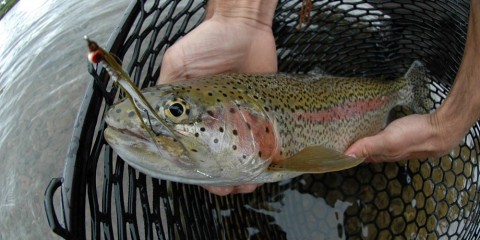
We deal with glare as we travel on the rivers and the sun is often above the horizon for 20+ hours. We see the most gorgeous rainbow trout in North America, the "leopard Spotted" variety and the char are brilliant. We often sight-cast to individual trout finning behind King Salmon redds. Polaroid dark glasses are essential for angler and non-angler alike. Bring a pair and if you wear prescription polaroid lenses consider a back up pair. I use "Smith-Action Optics" prescription lens’ in "Amber" or "first light" tints.

Polyester and other synthetic fiber clothes:
Layered from the skin outward you need:1 set Medium weight poly-pro long underwear tops and bottoms (poly-pro or capilene, or similar trademarks). We sleep snugly in this layer on cool nights or keep as a backup for storms. 1 set heavy or "expedition" weight polyester long underwear. We wear these under waders, and can substitute med-heavy fleece pile pants, winter fleece ski/cycling tights, or fleece wading pants / tights. (Cotton or silk gets damp & cold & clammy.)

"River pants" & shorts marketed as "Trekking, travel, rock climbing pants etc." Brushed nylon or similar quick drying & comfortable pants. 1 pair " river shorts" or swimsuit. You could make a case for cotton shorts. I wear a pair of synthetic quick drying North Face or Patagonia pants around camp in the evenings and mornings (if I take my waders off.)

1 med-heavy polyester "polar fleece" sweater, with or without "windstopper" inner layer. Patagonia markets "Synchilla" but each outdoor clothing vendor has trade names for their "polar fleece".

1 Cap to shield eyes from sun. Hopefully to be worn a lot! Plus, for backup, 1 ski cap of polyester polar fleece. Alternately a Gore Tex & polar fleece "Bomber" style with earflaps. "Outdoor Research" (OR) makes the bomber hat I wear in inclement weather. Gloves: I wear fingerless fleece type gloves when it is cool. Recommended highly after mid-August.

1 Long sleeve shirt. Brushed nylon "travel /trekking" shirt is best. This layer keeps pesky mosquitoes at bay and dries quickly. Cotton gets damp and stays that way for days. Some use an ultra light nylon "wind jacket" for this shirt layer. I cherish a loose fitting long sleeve North Face nylon travel shirt for insect protection. Light colors attract fewer mosquitoes than dark colors. BuzzOff works pretty well.

Fashion on the river: I am not immune to fashion concerns and get falsely & unjustly accused of being a model for unnamed outdoor clothing makers, so I won’t get too weird when you bring fashion statement Levis or "cotton-anything" if you have packed your essentials and stay within our weight limits.

Weather thoughts:
"Knock on wood" the Bristol Bay weather tends toward 60-75 degree days and nights to 45-60 degrees in June/July. The challenge in Alaska can be wind & humidity / & or rain. We don't know if we will get wind and rain but if we assume the worst we'll be happier for our preparedness. Humidity and dampness and wind degrade the insulation value of our clothes and sleeping bags, so we bring somewhat warmer clothing & gear than air temp alone dictates. If you are curious check the weather for Dillingham, DLG.

Sleeping bag, thermarest pad & compression stuff sack — I provide North Face and Mtn Hardware bags rated to 20 degrees, a "Thermarest Luxury edition" sleeping pad and a large compression stuff sack to reduce sleeping bag bulk.

Waterproof river-bag / duffels. — I provide one large (3.8 cu ft.) and one medium-small river bag per person. We pack our sleeping bag, thermarest and misc. clothes & toiletries in the large bag and your daytime needs raft/accessible clothing and misc. (binoculars, camera,) in the medium bag for accessible stowage near your seat. If you are bringing your own river bags, great!

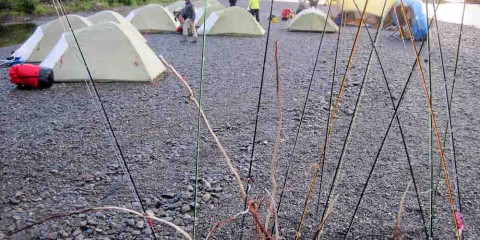
Tent- I provide 2, 3, or 4, person North Face or Mtn Hardwear 3 season tents. The critical features are a super seam sealed floor and a large fly.

If you are bringing your own tent: For 2 people for a week- 10 days my choice would be a 36-50 square ft. high quality 3 season tent by North Face, Mountain Hardware, Sierra Designs, MSR, REI, etc. The rain fly should be able to shed water well away from the tent floor. The tent floor seams should be not only factory seam sealed but gone over with a bottle / tube of seam sealer. The rain fly seams should be taped at factory and checked & sealed by hand if needed. Bring a "footprint" or tarp to protect the floor from gravel abrasion. Set the tent up in the house and go over the seams, poles, & details before the trip. There a more horror stories than you can believe about "new" tents with mismatched poles, or defective seam seals that are "discovered" on the first night of a wilderness trip.

Stove, cook set, plates, cups, spoons, etc. I use and provide MSR and "Lexan" cook gear. Cooking on wood fires on gravel bars below the seasonal flood line is a luxury we indulge in when practicable. Char and salmon Yumm!

Camp shoes / hiking boots:
1 dual-purpose pair of shoes for around camp & hiking works for most travelers. Trail running shoes or hiking shoes. My current favorite all-purpose shoe is mid wt. Gore Tex lined synthetic upper hiking boot. Also "Tevas" or "Chaco" / sandals get quite a bit of use around camp. If you want to emphasize daily hikes on your trip let’s discuss some really interesting ridge systems and adjust a schedule to fit.

Bug dope & headnets:
1 bottle of heavy-duty bug dope (Deet= active ingredient) / per person in fly vest or jacket pocket and 1 bottle extra per couple for backup / boat. Last summer I wore a head net for first time in 10 years. Bugs were troublesome for a couple of weeks in late June & early July due to the previous warm wet winter. If you want to pack a head net in your vest, great. Some wear hats that stow a rolled up head net on the brim.

Fire starter:
Both for emergency and routine campfire, stove etc. The plastic butane lighters are cheap enough to scatter through my clothes & fly vest & wader pocket and cook kit etc. Each of us carries some kind of fire starter. I lust after the $40 windproof lighters but don’t own one.

Flashlight or headlamp:
1 small "Mag-light" type or "Petzl" type headlamp (2-4 AA) for trips after July 10 to make reading in our tents a pleasure. Not needed in June/ early July.

First Aid kits: Always a good idea.
Our boats & camps will have well stocked kits. Waterproof sports adhesive tape is great for line cuts, which can be a problem with Chinook & Coho. A small first aid kit can be incorporated in a toiletries bag for "Band-Aids" & Ibuprofen / Tylenol necessities in the tent. Bring prescription drugs, and over the counter drugs as required. Misc. Towelettes / baby wipes. Great for getting bug dope off at night and general hygiene. Bring them if you like. I keep some in my toiletries kit. We’ll have soap, water, and wipes with the kitchen and latrine.

Fishing Gear:
What constitutes "enough" fishing gear?
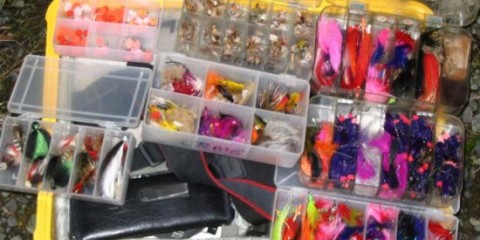
We fishermen are the worst at packing the "whole kitchen sink"! Me included. I would love to say just bring what you can fit in your fishing vest pockets. It really is possible! We need about 1 leader per day. 1-2 extra spools of 6#, 10#, 12# tippet. About 6 flies get snagged / lost per day, a little floatant, 1-10 various size split shot / day, 1 strike indicators / day, a forceps, a line nipper, pliers for unhooking salmon & crimping split shot, 1-2 extra spools of fly line, Polaroid glasses, bug dope. Same idea for spin and casting gear aficionados. The key is to sort through your gear about 4 times before your trip. Weed out and re-weed until it can all fit in your vest or jacket plus a small quantity of spares in a really small duffle about the volume of a standard shoebox. Taylor your selection of gear to the specific waters and types of runs we’ll fish.

Rods do break:
We case them up when we fly, but generally 2-4 rods are always at hand in the boat. I always pack two Sage fly rods for use as back ups should a rod tip break. The same for spinning gear. I will provide backup gear to match your chosen gear. If you are pursuing a line test record for King Salmon or other species just let me know.

Landing net:
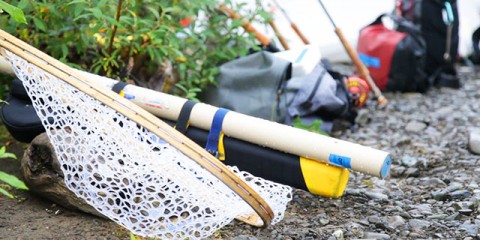
I provide a large soft release boat net.

GPS, Radios, Compass, Maps, Satellite, First Aid Kit:
I carry these. If you’d like to bring your own great! I can help you figure out what USGS maps we’ll be using or to download into a GPS. I carry waterproof 2/way radios to communicate between boats. I provide a Motorola Iridium phone. While we have never had a serious accident or medevac we have rescued numerous others who were not prepared. We carry first aid kits.

PFD's (personal floatation devices / life jackets):
Let me know what size you wear! I provide Extrasport PFD's in youth, small, med, lg/Exlg. If you own pfd's that are personally fitted & comfortable then you might want to bring those. We will be wearing them in the rafts so we want to be comfortable. Either way let me know your size or if I don’t need to pack pfd's for you.

Firearms & Bear Spray:
Talk to me if you want to provide your own. There are transport / aircraft issues.

Note:
My recommended gear brands are roughly listed in order of my opinion/assessment of quality based upon hardcore field use and ongoing industry product reviews. I appreciate economy and serviceability and I will help you with gear choices for your budget. I am not promoting or selling gear.


Client Words
“It was certainly a “road less traveled” that took Mark from an apartment in Chicago (as a boy) to the Alaskan tundra…He lived in Helena Mon..."
- John Merritt

View Testimonials


Home | About | Contact Us | Site Map