Wild River Guide Co. Fly and Tackle Discussion

The “Flies, Leaders, and Tackle Discussion” plus accompanying charts are organized chronologically from June through September. There are lots of fly patterns to select from that are effective and I’ve just included those that get the most use on my trips in the northern portion of the Bristol Bay region. The discussion covers topics related to fly choices, searching for migratory fish, the tackle, including leaders, appropriate to the task of turning over heavy flies, rods and reels, and both floating and sinking lines.

Early Season June 10 - July 10.

Sometime in May the ice is off our rivers. From April through late May, in Alaska, Rainbow Trout are spawning. Spawning is generally over by the end of the first week in June. This is of importance because the trout will have moved up into headwater or middle reaches of the river & creek to spawn. The post spawning dispersal spreads the fish out over the river and makes raft based fishing trips so effective because we can search for fish from the top through the middle reaches to the bottom.

Arctic Grayling like Rainbow Trout are spring spawners. The largest Arctic Grayling in the population move the farthest up into the headwater creeks and rivers, as much as 50-100 miles from their winter pools! Over the course of the summer this segregation of Arctic Grayling based upon size remains in effect with smaller fish more common in the lower reaches.

Dolly Varden Char, like their Brook Trout cousins, are fall spawners and most Dollies over winter in the river or lakes with river connections. Dollies tend to migrate downstream and out to sea or at least to the estuary in the spring. However some Dollies remain in the system as summer approaches feeding on aquatic insects, salmon fry etc.

When we are searching for Rainbow Trout, Grayling and Char in June through early July we are going to be most successful using fry, sculpin, lamprey, leech, and general attractor patterns such as purple egg sucking leeches (p.e.s.l.). Fly-fishing for Arctic Grayling in June is notably different from the other three species. Arctic Grayling are almost exclusively reliant on aquatic insects, Caddis, with a lesser reliance on Stoneflies, Mayflies, and fry in the early summer. Here is where the dry fly fishermen are going to shine! Caddis hatches in June can be spectacular, or not depending upon air and water temperature.

In mid-late June the first Chum, Sockeye, and Chinook begin nosing up the river but the first Chum Salmon aren’t dependably on their spawning redds until the end of the first week in July. The Chum spawn begins to focus the predatory trout and char in this early season. Meanwhile the early arrival Sockeye and Kings will be holding in deeper pools, large eddies below riffles, and places in the river with cover from aerial predation such as log jams. A late June or early July float trip ends among lower river salmon pools and for some the final day or two is spent with the big rod and the attractor patterns.

Lets consider the example of the Upper Nushugak or one of it’s tributaries in the third or fourth week of June. The first rod I’d line up is the 4-6 weight with a weight forward floating line and a 9 foot leader (RIO Atlantic Salmon Steelhead model. Tippet 6#). I’ll tie on an Elk Hair Caddis if the sun has been out all morning perhaps with a Pheasant Tail dropper. If it’s cool I might tie on a leech or wooly bugger. I’ll fish the light rod until I think I’m missing fish in the deeper runs. There is a temptation to think that adopting lighter leaders will confer some advantage for the headwaters and early season Trout, Char, & Grayling- indeed many have tried finer tippets. Lighter tippet doesn’t confer advantage in this fishery in the same way it does in spring creeks or heavily fished waters. Light tippets actually confer nerve wracking time spent untangling wind knots, breaking off trophy fish, and worse in this fishery.

Essential Flies, Leaders, and Tackle: June 10- July 10 prior to Salmon Spawning.

In this period Rainbow Trout, Dolly Varden, Arctic Char, Arctic Grayling, and Lake Trout feed on Salmon fry in rivers and lake outlets then become more widely distributed in streams and rivers feeding opportunistically on fry, sculpin, lamprey, snails, nymphs, caddis, and stonefly. Chum, Kings, and Sockeye sequentially enter the river system. The early Chum spawn beginning 1’st week of July. The largest Arctic Grayling remain farthest upstream feeding on aquatic insects & fry.

Arctic Grayling.

Rainbows, resident Arctic Char, Dolly Varden.

More Rainbows & Char Patterns.

King Salmon arrive in Lower river last week June.

Sockeye & Chum moving up the river.

Fly rod Options.

3-6 wt. Sturdy reel.

Fly rod Options.

5-7 wt Fast Action. Sturdy reel with adjustable drag

Same

Fly rod Options.

7-11 wt.

Sturdy reel with adjustable drag

Fly rod Options.

7-8 wt Fast Action. Sturdy reel with adjustable drag

Fly Lines RIO Grand, Scientific Angler Mastery (S.A.M) GPX, Teeny WF-Floating etc.

Fly Lines RIO Clouser or Bass. S.A.M Bass bug, Teeny WF-Floating or Pat Ehlers

Same

Fly Lines RIO Clouser, RIO 7’ DC Sink Tip. S.A.M Wet Tip,

Teeny Pat Ehlers Mini-Tip Plus or Tip Taper (sink)

Fly Lines RIO Clouser, RIO 7’ DC Sink Tip. S.A.M Wet Tip,

Teeny Pat Ehlers Mini-Tip Plus or Tip Taper (sink)

9’ Leaders, Rio Trout Knotless, 4X #6 tippet, Scientific Angler Mastery (S.A.M) Trout.

9’ Leaders, Rio Steelhead & Salmon Knotless #10 tippet, S.A.M. Salmon Steelhead #10

Same

9’ Leaders, Rio Steelhead & Salmon Knotless #20 tippet,

Teeny Salmon /Steelhead.

9’ Leaders, Rio Steelhead & Salmon Knotless #10 tippet, S.A.M. Salmon Steelhead #10

Dry Flies #12-14. Elk Hair Caddis, Parachute Adams, Blue wing Olive, Stimulators,

Royal Wulff,

Yellow Humpy,

Fry imitations, Conehead Fry, Thunder Creek,


Variety of Lg weighted leeches. Sizes 2# -4#

Sculpin 2#-4#

Olive Conehead Zuddler, Egg Sucking Woolhead Sculpin, Screamer, Olive Zonker.

Leader for Sinking lines 3-4 feet 12#-20# Maxima, RIO Max, or Teeny Salmon /Steelhead.

Sockeye #6- #10 Brassie, Comet,

Sockeye Orange, Teeny Sparkle Nymph & Sparkle Leech in hot pink.

Nymphs #10-16.

A.P Black, Hare’s Ear, Deep Sparkle Pupa, Black Pheasant Tail.

Most can be used as a dropper.

B&W Bunny Strip Leeches

Olive & W Strips. Dali Lama, Starlight leeches

Orange head white body & Tail.

Deer hair mouse,

Mercers Lemming

Nymphs- #6- #14 Bitch Creek, Prince Nymph, A.P Black, Yellow Stone Fly.

King Flies size #2-2/0. Volcano Bugger, Conehead Popsicle, Hareball Leech, MOAL, Articulated & Tube Fly Leeches, Teeny Flash Flies,

Chums #2 -4 #

Starlight leeches

Green head & Black body-tail, Hot pink, Ginger, Black nymphs, hot green sparkle leeches.


Teeny Nymph or Leech #2-4 ginger P.E.S.L. & variety Wooly Buggers & Krystal buggers for Rainbow & Char sizes 2# - #10

Egg Patterns ­when Chum spawn begins Nush & King Salmon R. end 1’st week July.

Teeny E.S.L’s, Marabou patterns. Orange, hot pink, chartreuse. A few dark colors- purple, black.

Egg Sucking Leeches in hot green

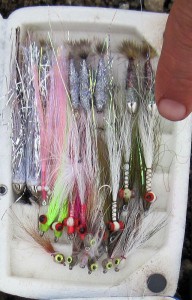
When setting up the 7 weight rod for the upper river in the early season we’ll use a weight forward floating line and a Salmon Steelhead #6-10 leader). I’ll tie on a 3-4 inch long weighted cone-head bunny strip leech in black & white or olive and white. The attractor value of flies like this is high enough early in the summer that Rainbow and Char will chase them. My other favorite pattern early in the season is Fry imitations, especially those glittery tinsel ones with eyes and a Conehead. Both Rainbow, Char, and larger Arctic Grayling love these and they are lots easier to cast than big leaches. Another great early or late season fly option is the White Sparkle Leech with an Orange head.

If it’s mid afternoon on our put in day, and we’ve fished for an hour or so, I’m going to say “Let’s go find some fish!” This begs the question: “Why leave fish to find fish”? It feels like the wrong thing to do! Let me explain a general difference between rivers with salmon and those without. In these upper reaches we are catching fish to be sure, from time to time. But our success is spottier than when we get into the middle reach. We catch some really large (potentially trophy) Arctic Grayling with huge iridescent sails that characterize the adult males. We will catch a large Rainbow Trout from time to time in deeper runs or structure. These fish took up positions after spawning but the majority of Rainbows have moved downstream to richer feeding zones where they can intercept salmon fry. So each mile of river is more productive than the last. The nutrients derived from generations of spawned dead salmon biomass accumulate in meaningful amounts in the reaches of the river below the large salmon spawning areas. Salmon fry have emerged from these gravels a month or two earlier. Let’s go find some fish!

Rod and Line considerations: If we are fishing 2 rods alternately during the day. The Arctic Grayling / Rainbow / Char rod would be whatever my favorite tried and true home waters trout rod is. My personal rod is a fast 5wt with a weight forward floating taper (Rio Clouser line in 5# and a leader with 6# tippet.). My second rod is a fast action 7 wt with a weight forward floating taper for the first couple of days in the headwaters (Rio Clouser in 7# with a nine foot RIO Salmon Steelhead leader 10 pound tippet); obviously a person can choose a 4 wt or 6wt with a second rod 2 steps larger. In my jacket pocket is a spare spool with a 7wt. medium density sink tip with three feet of Rio or Maxima 10 pound tippet. When in doubt I still over-line the rod by one size. On the smaller rivers that I favor, our casts average thirty to fifty feet. We know weighted flies cast lots better on larger lines with enough mass to dampen the chaotic peregrinations of the fly.

Raw data: Looking back through early July notes: in the stomach of a 3# Char killed on a tributary of the Mulchatna we found 4 lamprey eels and a 7 inch whitefish (imitate with Olive Dali Lama or Conehead Zuddler). On an Upper Nushugak tributary in early July 2006, several anadromous lampreys were found dead after making their spawning run. Stomach contents of Rainbow trout in July also contain caddis cases and snails. What seems true is that the trout are being opportunistic until the salmon spawn comes to dominate from Late July – September.

Salmon in the early season! Nothing defines the return of summer in Alaska more than the first salmon. And there is nothing like the sense of overwhelming power as a King Salmon makes its first run. Then again Sockeye are so acrobatic that an angler can make a good case for staying and fishing sockeye holding water for hours. Bright Chum are really tough. There is lot’s to love about Pacific Salmon including keeping a fine Sockeye or a jack King for dinner. Some of your camps will be at salmon pools with Kings Porpoising all night long. Hooking, not to mention landing thirty pound plus Kings is an unforgettable experience! I won’t go into tackle specifically for Kings here but there is a place for the heavy 9-11 wt rod if kings are a focus. If you have an interest we can correspond.

Your early salmon fishing success is considerably dependant on observing salmon in holding water. As we float we search constantly for salmon holding in pods or aggregations. Each time we find salmon holding the challenge is different than the last. The fish may be deep, they may be in the back eddy with counter rotating currents, they may be in such large numbers that we believe we can’t possibly miss! Each time we’ll try to attend to the basics of getting the fly to pass right in front of the salmon at their precise depth. We’ll figure the current and present flies from upstream trying not to line fish by pulling the leader over their backs.

A 7-9 wt. rod for Sockeye and Chum is perfect, and for that matter even the 7 wt. will work for the Kings if we have patience. We’ll want either a fresh 9 foot tapered Salmon Steelhead leader for the floating line or a 3-4 foot pull of 10-20 pound test tippet for the sink tip line. With fresh bright salmon the knot we use to tie leader to fly is quite important. A non-slip loop knot is best. Learn to tie it and you’ll use it on all subsurface presentations of leeches, buggers, salmon, tarpon flies or whenever you want to land large fish.

Fly selection for salmon. I generally start with the big black & white or olive and white Conehead that I’ve been searching for rainbows with. Next I’ll go for either hot pink or orange in Bunny Leeches, Teeny E.S.L’s or Marabou Buggers. If the sun has been on the fish all afternoon in clear water and hot colors are not working we’ll try smaller and darker patterns like Purple Egg Sucking Leeches, black nymphs, or Wooley Buggers etc.

Mid Season: July 10- July 30.

After 10’Th of July we generally have Chum Salmon spawning. The spawn may be intermittent. The spawn turns on during sunny days as the water temps rise and turns off on windy and cold days. If we can’t find feeding Char and Rainbows on or below Chum beds we will find them in the nearby log jams and root wads. Does the Chum spawn mean we only fish egg patterns? No but we are strategic and we dedicate the 4-5 wt rod to eggs for wading and sight fishing and the larger rod is for leeches and heavier search patterns. Howie Van Ness passes along the comment that there is one Fluorocarbon leader & tippet material that works well- Scientific Anglers Mastery Fluorocarbon II. So if you think the Fluorocarbon leader gives you an edge for presenting egg patterns this is the stuff. My personal favorite search pattern for the larger rod is a weighted attractor leech with an egg pattern on a twelve inch dropper. As we are searching for pods of salmon with the raft I’m quite confident that the leech and egg dropper will do a fine a job when cast among Chums on redds as it will searching around root wads!

Early Chum Salmon often spawn in small groups of 2-8 mature adults. We are looking for patches of clean gravel (generally on the outside bend) in a river bed of greenish to golden algae covered cobble. When we spot aggregations of Chums “laid up” we will beach the raft and wade to sight fish with the light rod. Egg imitations to drift through the early Chum spawning redds (otherwise called “beds”) include orange, peach, & cerise Glo-bugs. Glo-bugs are arguably more effective egg imitations by virtue of their large size. So when the Chum spawn is intermittent in the early season and Char or Trout aren’t yet satiated Glo-bugs can be seen from a greater distance as a searching pattern. As you drift the egg pattern note that if you are catching almost exclusively Grayling that the bug is probably not deep enough. Add split shot and lengthen the distance from the strike indicator.

Essential Flies, Leaders, and Tackle: July 10- July 30.

Chum spawning, Sockeye & Kings set up territories, Trout and resident Char gradually switch to eggs. At times feeding exclusively on eggs.

Arctic Grayling

Rainbows & Char, Sea run Dolly Varden enter.

More Rainbows & Char Patterns.

Kings

Sockeye, Chum, Coho. First Coho last week July.

Fly rod Options.

3-6 wt. Sturdy reel with adjustable drag

Fly rod Options.

5-7 wt Fast Action. Sturdy reel with adjustable drag.

Fly rod Options.

Same.

Fly rod Options.

7-11 wt.

Sturdy reel with adjustable drag.

Fly rod Options.

7-9 wt Fast Action. Sturdy reel with adjustable drag.

Fly Lines RIO Grand, Scientific Angler Mastery (S.A.M) GPX, Teeny WF-Floating etc.

Fly Lines RIO Clouser or Bass.

S.A.M. Bass bug, Teeny WF-Floating or Pat Ehlers .

Fly Lines.

Same

Fly Lines RIO Clouser, RIO 7’ DC Sink Tip. S.A.M Wet Tip,

Teeny Pat Ehlers Mini-Tip Plus or Tip Taper (sink).

Fly Lines RIO Clouser, RIO 7’ DC Sink Tip. S.A.M Wet Tip,

Teeny Pat Ehlers Mini-Tip Plus or Tip Taper (sink).

9’ Leaders, Rio Trout Knotless, 4X #6 tippet, Scientific Angler Mastery (S.A.M) Trout.

9’ Leaders, Rio Steelhead & Salmon Knotless #10 tippet, S.A.M. Salmon Steelhead #10.

Same

9’ Leaders, Rio Steelhead & Salmon Knotless #20 tippet,

Teeny Salmon /Steelhead.

9’ Leaders, Rio Steelhead & Salmon Knotless #10 tippet, S.A.M. Salmon Steelhead #10.

Dry Flies #12-14. Elk Hair Caddis, Parachute Adams, Blue wing Olive, Stimulators,

Royal Wulff,

Yellow Humpy,

Egg imitations fished behind aggregations of Chums. Beads,

Glo-bugs, Illiamna Pinkies, etc.

Sculpin sizes 2# 4#

Olive Conehead Zuddler, Egg Sucking Woolhead Sculpin, Screamer, Olive Zonker.

Leader for Sinking lines 3-4 feet 12#-20# Maxima, RIO Max, Teeny Salmon /Steelhead.

Sockeye #6- #10 Brassie, Comet,

Sockeye Orange, Teeny Sparkle Nymph & Sparkle Leech in hot pink.

Nymphs #10-16.

A.P Black, Hare’s Ear, Deep Sparkle Pupa, Black Pheasant Tail.

Most can be used as a dropper.

Variety of Sizes 2# 4# leeches. B&W Bunny Strips

Olive & W., Dali Lama, Starlight leeches Orange and White.

Deer-hair Mouse,

Mercers Lemming.


Flesh flies begin! Ginger bunny above an egg dropper.

King Patterns in size #2/0- #2 High Quality Tiemco, Owner, or similar hooks. Teeny Flash Flies, Teeny E.S.L’s, Conehead Popsicle,

Chums #2 #4

Starlight leeches

Green & Black, Hot pink, Ginger, Black nymphs, Sparkle leeches. & E.S.L’s hot green.


Teeny Nymph or Teeny Leech #2-4# Color Ginger.


P.E.S.L. & variety Wooly Buggers & Krystal Buggers.

Generally too much egg pattern & leech action to use nymphs.

Fry Patterns occasionally.

Hareball Leech, MOAL, Articulated or Tube fly leeches, Marabou patterns. Orange, hot pink, chartreuse. A few dark colors.

Coho #2- 4# Hot Pink Sparkle Shrimp, Dali Lama, Flash Flies, Starlight Leeches, Flashabou -P.E.S.L.

Pink Polly Wogs!

Mid season is the time of building numbers of pre-spawn salmon in the river. The seams and eddies below islands, the sloughs formed by back channels, and the mouths of creeks will hold dozens to hundreds of salmon. They are maturing sexually and metamorphosing from sleek silver bullets to hook-nosed red monsters. Rainbow and Char are still found in structure ambushing fry, as well as the tail outs but more and more are focused below Chum beds. Mobility to search for fish is key. We’ll find ever larger chum beds as the season progresses and as we descend the river through the middle reaches.

Fly selection is similar to early season for Grayling, Trout, and Char although Fry patterns are no longer very effective. The big bunny strip leeches remain terrific. Beads are the most effective mid season egg imitations when the Chum spawn is turned on and we are sight fishing. Howie Van Ness passes along the observation that there is one Fluorocarbon leader & tippet material that works well- Scientific Anglers Mastery Fluorocarbon II. So if you think the Fluorocarbon leader gives you an edge for presenting egg patterns this is the stuff. For beads, the kits available from the “Alaska Fly Shop” and other knowledgeable shops are a great way to go. In any case get an assortment put together by someone familiar with the river and the week we will be fishing. Chum eggs are different than Sockeye eggs and so on.

How many leeches, buggers, zuddlers etc will you lose in a day? Probably no more than _ dozen per day if you have brought proper Salmon-Steelhead leaders.

The Best for last. Late season. August through September 15.

We begin August under summer weather conditions and often end it with monsoonal Bering Sea storms. The Rainbow Trout and Dolly Varden Char fishing in the prime Sockeye spawning water is unbelievable. The Char are returning back to the river from the estuary, literally pouring in, timed for the Sockeye spawn. When we are fishing; the minutes can give way to hours where every time you look at your partner down the gravel bar, or in the other boat, a fish is being landed. It becomes hard to take time out for lunch, a bagel with crème cheese and smoked salmon is wolfed down and you return to the fishing. Your success happens for two reasons. First you got yourself here to this pristine river and second because you are attending to all the fundamentals of fly selection for the conditions and presentation.

Although August conditions can be sublime the weather can never be taken for granted. One looks over one’s shoulder at the clouds on the horizon, watches the barometer, and prays for good flying weather. We come prepared for wind and rain with our Gore-Tex XCR jacket & waders and our well considered camping gear so we can camp and fish in most all conditions. You plan your trip with a bit of a “weather cushion” factored in- anticipating perhaps by mid-August that 1-2 days out of seven may not be flyable.

In the upper river in late season the Chum spawn will be near complete and the trout and char attending the last pods of spawners. Few Trout or Char will be found in “likely looking holding water” if there aren’t spawning salmon immediately above. You pass through the upper reaches catching some fish, to be sure and into the middle reach where the Sockeye spawn will be in full swing. Here you slow the progress and wade sight fishing to the spawning beds. The big leech with an egg trailer is a great way to go, as is the bead below an indicator.

Essential Flies, Leaders, and Tackle: August 1- September 15.

Chum spawn declines, Sockeye spawn becomes a big magnet. Kings spawn, Trout, Arctic Grayling, Char on eggs. Coho & Bigger Pre-spawn Dollies continue to enter system. By end August Coho & Dollies far up in the rivers, Rainbow on flesh & eggs, sculpin & large leeches. Use heavier leaders with Coho in rivers.

Arctic Grayling

Rainbows & Larger Dolly Varden Char

More Rainbows & Char Patterns

Sockeye, King, Chum, Pink.

Coho in large numbers

Fly rod Options.

3-6 wt. Sturdy reel with adjustable drag

Fly rod Options.

5-7 wt Fast Action. Sturdy reel with adjustable drag

Fly rod Options.

5-7 wt Fast Action. Sturdy reel with adjustable drag

Fly rod Options.

7-9 wt.

Sturdy reel with adjustable drag

Fly rod Options.

7-9 wt Fast Action. Sturdy reel with adjustable drag

Fly Lines RIO Grand, Scientific Angler Mastery (S.A.M) GPX, Teeny WF-Floating etc.

Fly Lines RIO Clouser or Bass.

S.A.M. Bass bug,

Teeny WF-Floating or Pat Ehlers.

Fly Lines.

Same

When late run bright Sockeye etc are present they can be taken on tackle and flies for Coho.

Fly Lines RIO Clouser, RIO 7’ DC Sink Tip. S.A.M Wet Tip,

Teeny Pat Ehlers Mini-Tip Plus or Tip Taper (sink).

9’ Leaders, Rio Trout Knotless, 4X #6 tippet, Scientific Angler Mastery (S.A.M) Trout.

9’ Leaders, Rio Steelhead & Salmon Knotless #10 tippet, S.A.M. Salmon Steelhead #10.

Same

Note these Salmon species generally incidental now. Not targeted on spawning redds.

9’ Leaders, Rio Steelhead & Salmon Knotless #10 tippet, S.A.M. Salmon Steelhead #10.

Dry Flies #12-14. Elk Hair Caddis, Parachute Adams, Blue wing Olive, Stimulators,

Royal Wulff,

Yellow Humpy.

Egg Patterns fished behind Chums & Sockeye & Kings. Beads, Glo-bugs, Illiamna Pinkies.

Sculpin sizes 2# 4#

Olive Conehead Zuddler, Egg Sucking Woolhead Sculpin, Screamer, Olive Zonker.


Sizes #2- #4 Hot Pink Sparkle Shrimp, Dali Lama, Flash Flies, Variety Starlight Leeches, & Flashabou -P.E.S.L.

Nymphs #10-16.

A.P Black, Hare’s Ear, Deep Sparkle Pupa, Black P.T. Nymph. Pheasant Tail.

Most can be used as a dropper.

Variety of 2# -4# leeches. B&W Bunny Strips

Olive & W., Dali Lama, Starlight Leech Orange and White .

“Egg Dropper” 12 inches behind Flesh or Leeches where regulations permit.


Deer hair mouse!

Mercer’s Lemming


Variety Polly Wogs & Techno Wogs mainly pink but some purple. Bunny Flies loud colors.

Egg Patterns

Teeny Nymph or Teeny Leech #2-4# Color Ginger.


P.E.S.L. & variety Wooly Buggers & Krystal Buggers.

Flesh flies!! Ginger bunny above an egg dropper. White Conehead Zuddler.


Pink Salmon In Even Years. P.E.S.L., Flash Fly, Sparkle Shrimp, Fuscia Bunny.

As the river gradient flattens out on your float fishing trip you want to be on a “reach” of river where the spawning gravel and the water conditions are perfect. One can not tell where that perfect water will be from looking at a map, or viewing the water in the spring, one has to let the salmon judge for themselves. But when you have found it by finding the salmon; you will have found some of the finest wild trout and salmon fishing in the world!

You will have been catching Coho all week with all the thrill that entails! When they are “laid up” in a small pods, behind gravel bars, and in soft water by Beaver lodges, one or two of the most aggressive fish will slam the big leech. Mornings you can throw the Polly Wog and watch the jaws emerge from the still slough water and inhale the fly. The fishing is so strong in August that only the weather can make it difficult.

Big Rainbow Trout and Char: Perhaps you want to focus on trophy Trout, Char, or Salmon later in the trip. A big Rainbow or Char on the Upper Nush or tundra rivers out west is above 24” inches. Hooking a twenty eight - 28” inch Rainbow in August gorged on salmon eggs will stun you into thinking you’ve got a really hot Coho. Every year, fish of 30” inches are released on these remote rivers. There isn’t a single formula for success on these “Old Growth Fish” but there are techniques that stack the odds in your favor. First of all we occasionally spot them with our Polaroid Glasses sight fishing behind spawning Chum & Sockeye. This will put your heart in your mouth. Second we find them in the deepest and swiftest water with standing waves. Third, a bit counter-intuitively we find them on the insides of bends in 16-30 inches of slow moving water in the lower reaches. The fourth and single most important factor is that we hook more of them on rivers & streams that get little if any angling pressure.

What we have learned about “old growth fish” is to work all these areas with big leeches & to keep moving until you find them. Two partners fishing as a team will know if there is a really big fish in a run within 20 minutes, because you will have “tagged” it, if not move on. You’ll note the Rainbows chase your sculpin and leeches and then “tap” it at the bottom of the swing. The experienced angler uses a strip strike and if the fish missed the hook drops the fly back. The big aggressive fish strike it again after you twitch it and begin to strip it back to you.

On the Lower River with a Fly Rod, the Wind, and Salmon. Coho on a blustery day when the Bering Sea wind is in your face require attention to both the fundamentals of fly-fishing and of safe Alaska outback travel practices. First and foremost; wade & boat safely! Water over the top of waders can change the focus from fish to health and safety in a heartbeat. The fish are there in the lower river in numbers, perhaps huge numbers. You catch a dozen Coho and get into the rhythm of casting- and stripping- and striking- and landing big fish. But one has to pay attention to the fundamentals now. This is when you will break your favorite 7-8 wt rod! It’s all going beautifully but you hurry to land & release the Coho a bit “green”…It happens to us all!

A couple of things to remember. Number one any time you travel in the Alaskan bush please be safe- fish with a buddy, wear your Polaroid glasses, keep fire starter in an inner pocket, and wear your wading belt! Two; re-tie your fly with a solid non-slip loop knot after several fish. Three; re-check the ferrules of your rod. Four fish deep! Finally after a half dozen fish, walk back to camp or to the raft and have some hot tea and a snack. Sit and watch your partner, friend, or your wife-husband struggle with a big wild fish! Laugh. Last; remember that the truly outstanding Rainbow Trout are hooked in the lower reach of the river where the biological accumulation of food resources is highest and where during Coho season we are likely to be distracted fishing for Coho!

Parting considerations on fly and tackle selection: From prior experience we’ve learned that you can eliminate bringing a fly-vest if you set up your Gore-Tex jacket with hemostats, line nipper, and stock the pockets with leaders & flies. Neither neck lanyards nor fishing packs/ pack vests have proved useful in this type of fishery.

Don’t feel compelled to bring the whole Fly list, just bring those that you’d like to fish and then fish them deep! One normally will share flies among your group to even out the individual selections. Be creative! We learn about a great new fly every year sometimes every week!Passionate about dry flies? Who doesn’t love large trout rising to dries? I mentioned the Caddis hatch from late June (or whenever the water temp is above 50 degrees) through July and into early August. The naturals are dark brown or olive brown. We have Yellow Stoneflies all season and a few small mayfly hatches.

For an Alaska trip ask yourself: Am I coming to Alaska to fish dry flies or am I coming to Alaska to catch large fish on flies. If you are consumed by dry flies and have caught big Leopard Rainbows by other means then let’s design a specific trip around a late June - early July timeframe on a reliable hatch producing stream. I keep Elk Hair Caddis, Royal Wulff, Yellow Humpy, Rio Grande Trudes, Parachute Adams or other parachute style hi visibility flies in my box. Sizes 12-16. Bring high floating flies that you can see! Plus floatant. A mixed dozen should do it.
Mice, Lemmings, Voles, and Shrews. 6 mice for a week (plus floatant) should do it when we find Rainbow Trout & Char in the mood. You may also sacrifice a couple Mice to Northern Pike when you are on the Upper Nushugak or among the Wood-Tikchik Lakes. Bring a small coil of light steel leader, or hard mono for the Nushugak Pike. You will need floatant to “skate” the mice over areas where you can see Rainbows. When mice work you won’t want to catch Rainbows any other way.

Fly Rods: For general Bristol Bay conditions I prefer a fast action 7-wt rod. In addition to the 7-wt in June/July I pack a 5-wt. In August/September it’s a 7-wt and a 9-wt. Anglers are happy with everything from Reddington and St. Croix rods to Sage Z Axis and there are valid reasons for the spectrum of choices. I prefer “faster” rods because we are lifting the weighted leech from under 2-4 feet of water up to the surface and then accelerating it with the back cast and I believe the rod needs to load quickly. But others enjoy the rhythm of a slower action. Durability might be valued over finesse for a week in the wilderness. In the end bring 2 rods per person that you are comfortable with.
Reels: I am surprised every now and again when an Alaskan fly fisher is inspired to use a “pawl & click” drag reel for anything larger than Grayling. I have witnessed some spectacular failures of the older “Hardy Perfect” & “Pflueger Medalist” reels. One guest’s hand was slightly injured by an (inadvertent) King Salmon hookup on a “pawl & click” drag Hardy reel in July 2004. I think you will be happiest with contemporary fly reels with a good drag! I see Ross, Sage, Tibor, Abel, Lampson, Galvan, Islander, Bauer and many other reels doing a great job.
Lines: I prefer weight forward floating lines in 5-10 wts. for small and medium size Bristol Bay rivers but you may prefer something else entirely. On the lower river in deeper waters sink tip and density compensated sinking lines are great and they are covered with a second spool for the heavier rod. I’m happy with most of the better quality lines designed for throwing Bass bugs, Pike Flies, Clousers, and Bonefish flies. I’m personally best acquainted with RIO Lines, followed by Scientific Angler, and Teeny lines. While writing this section I spoke with Jim Teeny and Howie Van Ness at length, consulted with The Alaska Fly Shop, and the Alaska Rep for RIO.

Matching Line Sizes to our Fly Rod: If the line is more a “general purpose” line like the RIO Grand, or Scientific Anglers Mastery GPX, or Teeny WF Floating it still makes sense to overweight the line by one # wt. for my favorite Bristol Bay rivers and creeks because we are not casting for distance as much as to quickly shoot the line 30-50 feet. If it is a specialty line like the RIO Clouser, Teeny Pat Ehlers, or a Bass and Pike taper match the line weight to the rod wt. A second spool with an intermediate sink tip for the heavier rods (7-9wt) is called for. Lines such as RIO 7’ DC Sink Tip or Pat Ehlers Mini-Tip Plus for the 7-8 weight rod, and perhaps a Teeny Tip Taper for the 9-10 wt. The 4-6 wt rods are fine with just a properly matched floating weight forward line.

Leaders: I’ve used 9 foot Rio “Atlantic Salmon- Steelhead” leader in both 10# and 6# tippets with good results for ten years. Knot strength is good, abrasion resistance is good. Bring one 9 ft. tapered Salmon-Steelhead leader per day plus bring a spool of 6-10#, tippet for Trout & Char and 10-15 #tippet for Coho, Sockeye, Chum. A spool of 15-20# tippet for King. Also my guests are very happy with Maxima leaders and rarely break off a fish. Howie Van Ness passes along his experience that the Scientific Anglers Mastery Salmon Steelhead leaders are excellent! I can’t tell you the number of problems I’ve witnessed with Orvis trout leaders, fluorocarbon in general, and typical “dry fly finesse presentation” leaders. Guests were happy with The Fly Shop’s Targus 2X, 10.5 # leaders in 2007. The fish are not generally leader shy but they are large and you are throwing large flies. Bring good leaders with long, heavy, butt sections designed for Alaska!

Fly presentation: Most of us can catch a reasonable # of fish in Alaska if we can just keep the fly in the water. But if we are on good Salmon, Trout, and Char water and we are not catching them regularly it is most likely because we are not fishing deep enough or we are not detecting strikes. So approach the Alaskan trout fishing a bit like steelhead fishing, and if you aren’t breaking off flies on the bottom, & root wads, then you aren’t deep enough. If you are fishing a floating line, which is what I generally do, and your fly is un(der)-weighted then use split shot about 6” above. The shot gets it down and then the fly rides up a bit above the shot. Also problematic is the number of strikes that go undetected. Some years I have fished an indicator every day all season! Other years I just fish an indicator on the days I want to catch fish! That is not far off the truth! On the other hand good wet fly fishers can do fine without an indicator…Still bring some good yarn or “Corky” style indicators.

Client Words
I want to thank you and Richard for hosting a fishing trip from which I harvested an abundance of wonderful memories and new friendships...
- Craig Roberts

View Testimonials


Home | About | Contact Us | Site Map